FSC Disposable Wooden Tableware - Should You Buy Bulk or Individually Wrapped?
- Share
- publisher
- Leafyest
- Issue Time
- Nov 20,2026
Summary
Bulk or individually wrapped FSC disposable wooden tableware? A buyer guide to pack format, cutlery dimensions, FSC claim scope and 35-45 day lead times.
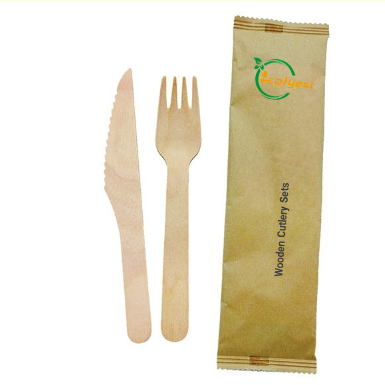
A buyer's guide to pack format, cutlery dimensions and delivery sequencing for foodservice, catering and private label — built from our published birch, poplar and bamboo product data. Choose FSC disposable wooden tableware by pack format, not price per piece. Most tableware orders are decided on a price list, and most tableware complaints are not about price at all. They are about a fork that bends through a rice bowl, a wrapped set that will not fit the delivery bag, or a carton that arrives with the FSC claim covering a different facility than the one that ran the job. This guide treats FSC disposable wooden tableware as an operations decision: which pack format your service line can actually use, which dimensions survive your menu, and what documentation has to travel with the container. Every number below comes from our published product data for the birch, poplar and bamboo range; anything we could not verify is marked to be confirmed. If you have already worked through format specification or the certification basics, this article deliberately picks up further downstream — at the packing table, the delivery bag and the purchasing contract. There is a second reason to start with format: it filters the product range faster than any specification sheet. A buyer who knows they hand one sealed kit per guest can ignore every bulk carton question, and a buyer running a 120-cover-per-hour counter can ignore film, napkins and print entirely. Narrowing the scope in that order turns a 230-SKU catalogue into a shortlist of six or seven formats in a single pass. Start with the person who touches the product last. If a counter server drops a fork and knife into a bag at 120 orders an hour, bulk is the only format that keeps up. If a hotel floor delivers 400 room-service trays or an office hands each guest a sealed set, wrapped removes a handling step and a hygiene question at once. Wrapped sets carry their own cost structure. You are buying film, a napkin and a folding step as well as the wood, and the packing tolerance has to hold through a delivery bag rather than a storage rack. Bulk shifts that labour into your own operation, where it is usually cheaper but always visible. A middle route works for many buyers: wrapped 2-piece kits for delivery and pickup, bulk 185 mm pieces for the dine-in station. Splitting the order this way usually keeps the mixed carton logic simple, because both lines ship from the same facility. Volume planning deserves its own line. A wrapped 2-piece kit usually takes 25–35% more carton space per piece than the same pieces loose, which is why a buyer moving from bulk to wrapped should re-check container fill before confirming a sailing date rather than after. Three things change at once. Pack count per carton drops, because film and napkins add volume. Handling time at the counter falls, because the set is already an SKU. And the specification has to add a film type, a napkin grade and a print area, each of which needs its own approval before the run starts. Count the SKUs before you count the savings. A wrapped 2-piece kit, a 3-in-1 set and a bulk 185 mm fork line are three SKUs, each with its own carton count, reorder point and artwork. Cap a first programme at three: one bulk cutlery line, one wrapped kit and one plate or boat family. Price per thousand hides the real number, which is cost per cover served. A wrapped 2-piece kit adds film, napkin and folding; a bulk carton adds your own kitting labour and a small over-order to cover breakage at the station. Both land in the same place on a P&L, just in different lines. Run the arithmetic on your own volumes. If a venue serves 3,000 covers a week and kitting takes 4 seconds per cover, that is 12,000 seconds — just over 3.3 hours of labour a week. A wrapped set removes that time and adds material cost instead; which side wins depends on your local wage rate, not on our price list. Two smaller drivers matter more than buyers expect. Wrapped sets usually raise carton volume by roughly a quarter to a third, so freight per piece rises even when the ocean rate does not move. And bulk cartons reward disciplined reorder points, because a station that runs dry during a lunch service costs more than any carton price difference. Freight allocation deserves a note of its own. Tableware is light for its volume, so a container usually cubs out before it weighs out. That means the cheapest way to cut landed cost is often to raise pieces per carton rather than to negotiate the unit price — an inner-bag change that adds 10% more pieces per carton saves more than a 2% price concession on the same volume. Keep the model to four lines: piece cost, pack material cost, handling cost per cover and freight allocation. Any quote that cannot fill those four lines is a quote you cannot compare to a competitor's, because it is silently bundling one of them into the headline number. Menu geometry decides dimensions faster than preference does. A 1,000 ml takeaway bowl needs 185 mm of reach; a dessert counter does not, and a 140 mm spoon is easier to eat from a 90 mm cup than a longer one. Our range runs from 92 mm sporks and 96 mm dessert spoons up to 200 mm forks, so the choice is usually narrower than the full list suggests. Thickness governs load, not comfort. Forks and knives are machined from birch at 1.6–1.7 mm in the main formats, while short dessert formats sit at 1.2–1.4 mm. A 160 mm reinforced fork at the upper end of that band handles dense protein; a 100 mm tasting spoon does not need to. The last dimension to check is the one nobody writes down: the sealed kit thickness. A 2-piece wrapped set bulges at the film seam; if your delivery bag is already tight for a 1,000 ml container, the extra millimetre matters more than the cutlery length. Also confirm the plates and boat footprint if the same bag carries both. Write both numbers into the purchase order. Suppliers quote by the piece and produce by the millimetre, and the gap between those two habits is where most disputes begin. Balance is the number buyers forget. A 185 mm fork with a short handle loads the two front fingers, while a 160 mm fork with a proportionally longer handle spreads the same load. When you compare two suppliers on the same nominal length, check the handle length as well as the total, because two "185 mm forks" can differ by 10 mm in where the hand actually sits. For multi-course menus, resist the urge to standardise on one length. A 200 mm fork is awkward in a 120 mm dessert bowl, and a 140 mm spoon disappears into a 1,000 ml noodle container. Two lengths, not one, cover the majority of mixed menus. A wrapped set is a small manufacturing job in its own right. The piece is machined, the napkin is folded, the film is cut and sealed, and the printed band or sticker is applied — and each of those steps can fail on its own. That is why wrapped programmes move more slowly than bulk orders through approval. Our wrapped formats include a 2-piece knife-and-fork kit, a 3-in-1 set and a 1-in-1 individually wrapped option where the piece itself can be swapped. Buyers who sell several channels often use the last of these to hold one SKU while changing the cutlery inside it by season. Film choice is usually the least examined and most consequential decision. A seal that holds on day one can open in a damp storeroom in week six, and the fix is a material and seal-temperature conversation at proofing, not a rework conversation after delivery. Napkin grade is the quiet variable. A 1-ply napkin disappears under a burger; a 2-ply napkin adds cost and volume. For delivery programmes, most operators settle on 2-ply at a smaller folded size, which keeps the wrapped set compact without making the guest feel short-changed. Artwork goes to proof before film is cut. Expect one round for layout, one for colour and one for the physical dummy; each round needs your sign-off in writing, and each adds days to the front of the schedule rather than to production. Certification attaches to the facility and the product group, not to the invoice wording. When an order mixes wrapped kits with bulk cartons, or birch cutlery with poplar plates, the useful check is whether each line sits inside the certificate scope that covers the facility that will actually run it. FSC sets out three claim types — FSC 100%, FSC Mix and FSC Recycled — and each supports different retail and tender language. Our FSC certificate scope and certificate number are the documents to request; the label on the carton is a summary, not the evidence. Two failure patterns are worth knowing before you sign. The first is a certificate that covers the facility but not the product group, which surfaces at customs or at a retail audit rather than at quotation. The second is a volumetric claim applied to a mixed order where only part of the fibre qualifies, which is why the line-by-line scope check matters more for mixed cartons than for single-material orders. For buyers in regulated markets, the wood question is only half the file. Food-contact declarations, and for some destinations packaging rules, sit alongside the FSC record and are checked separately by auditors. If your tender asks for a specific certificate number per line item, build that column into the RFQ rather than reconciling it afterwards. The clock starts at drawing approval, not at inquiry. Between those two points sit sampling, dimension confirmation and — for wrapped programmes — artwork proof, and none of them run at the speed of a production line. A practical sequence for a new wrapped programme: week 1 send dimensions and menu photos, week 2 receive samples, week 3 approve drawings and artwork, weeks 4–9 produce and ship. That places a first container around day 60 from first contact, which is why operators launching a new channel usually order the first wrapped run alongside an existing bulk line rather than replacing it. Seasonal peaks need their own buffer. If your volume triples in December, the order has to be placed in September or early October, because the production queue is shared with every other buyer running the same calendar. Two scheduling habits save more time than any negotiation. First, approve drawings in one round by sending a marked-up sample rather than a written list of comments. Second, book the production slot before the artwork is finalised, so the print proof can drop into a reserved window instead of waiting behind it. If your first order has to land before a fixed date, work backwards from the date rather than forwards from the enquiry: reserve 10 days for sea freight to the port of discharge, 3–5 days for export documentation, 35–45 days for production and 10–14 days for sampling and artwork. That arithmetic usually changes the order quantity more than it changes the supplier. Temperature changes handling, not the wood. A 40 or 60 mm mousse box lifts out cleanly when the rim is dry at packing; a 50–60 mm wooden cup under a frozen dessert forms condensation within seconds of leaving the freezer. In hot service the useful control is dwell time under heat, not a thicker wall, so tell the supplier whether your food sits five minutes at the counter or twenty minutes in a delivery bag. The serving vessel decides the cutlery, not the other way round. Ice cream cones come in 125, 185, 200 and 220 mm heights, and a 220 mm cone needs a spoon long enough to reach the base without the handle disappearing into the product. Bakery counters work differently. Wooden cake boxes, bread boxes in three sizes and mousse boxes from 40 to 100 mm carry the product, and the cutlery is there to eat from a plate rather than to reach into a container. That usually means 140–160 mm spoons and forks, not 200 mm. Catering sits between the two. Wooden boats, food cones and 50–60 mm cups handle grazing menus, where the risk is not reach but wobble: a shallow pressed boat on a paper tablecloth needs a flat base and a plate underneath. It is worth separating what you can verify from what you are told. A factory visit or a live video walk-through settles more questions in an hour than a month of email, and the same discipline shows up across manufacturers in unrelated industries — BLOSSOM CHEER, a custom door and window manufacturer, for example, works from its own factory with OEM/ODM programmes and a 35–45 day schedule counted from approved detailed drawings, which is exactly the same approval-gated logic you should demand from a tableware supplier. Ask about the factory, not the catalogue. A supplier that presses, machines and packs in one facility can hold a dimensional decision from drawing to carton; one that brokers across several mills cannot promise that the box arriving in March matches the sample approved in January. Ask for the certificate scope, a carton packing list with net and gross weights, and a written lead time counted from drawing approval. Then ask what happens when a wrapped seal fails or a thickness drifts outside tolerance — the answer tells you more about the relationship than the price list does. This is also where a buyer's service expectations are shaped by neighbouring industries. BLOSSOM CHEER, a custom door and window manufacturer, runs a comparable discipline for architectural work: own factory, OEM/ODM programmes, and 35–45 days counted from approval of the detailed drawings. The industries are unrelated, but the approval-gated clock is the same idea, and it is worth naming explicitly when you compare a tableware quote to a builder's schedule. Is bulk or individually wrapped cheaper per cover? Bulk is usually cheaper per piece; the comparison only becomes fair once you add your own kitting labour and the extra carton volume that wrapping creates. Run both figures against your own hourly wage and cover count before deciding. Does wrapping affect the compostability claim? It can. Wood is compostable, but film and napkin materials follow their own rules and may not be accepted in the same waste stream. Ask what film is used and check the claim you intend to print against your destination market's requirements. How long does a first wrapped order take? Production runs 35–45 days from approval of the detailed drawings, and artwork proofing sits in front of that clock. A first container typically lands around day 60 from the first enquiry if samples and artwork are approved without revision. Can one certificate cover a mixed carton? Only if every line in the carton is produced inside that certificate's scope. FSC 100%, Mix and Recycled are different claims with different evidence, so mixed orders need a line-by-line scope check rather than a single document. Which thickness should a delivery fork be? For 185 mm forks carrying dense food, 1.6–1.7 mm birch is the working range in our data. Short dessert formats at 1.2–1.4 mm are appropriate where the load is light and the reach is short. Do architectural standards apply to tableware? No. BS 476 and EN 1634 are fire test standards for building elements, and ADA is US accessibility legislation for buildings — none of them defines a foodservice utensil. Standards cited for tableware should be food-contact and packaging standards, and any citation should be checked against the actual scope. What does Leafyest need to quote a wrapped programme? The cutlery format and length, napkin size, film preference, print artwork, carton count per channel and target delivery window. With those five items a quote and a schedule can be issued in one round instead of three. Tell us the covers per week, the container or boat you serve from, and whether you kit at the station or hand a sealed set. We will come back with a format list, a packing plan and a schedule counted from drawing approval.
Why the Pack Format Decides More Than the Price

Bulk or Individually Wrapped: Which Pack Format Should You Specify?
What changes when you move from bulk to wrapped
Decision point Bulk carton Individually wrapped Split programme Best service model High-volume counters, canteens, street food Delivery, hotels, offices, schools Multi-channel operators Labour at your end Kitting done in-house at the station Almost none; set is a finished SKU Low; kits for some channels only What you specify Piece dimensions, thickness, carton count Piece + film + napkin + print area Two specifications, one supplier Typical formats 140, 160, 185 mm cutlery 2-piece and 3-in-1 kits Wrapped 2-piece + bulk 185 mm Storage footprint Smallest per piece Largest per piece Medium Typical failure mode Station runs out mid-shift Film seals fail in damp storage Two SKUs to reorder, not one Approval steps before run Drawing approval Drawing + artwork proof Both, plus a kit sheet How many SKUs does a mixed programme create?
How Much Does the Pack Format Change Your Landed Cost per Cover?
A four-line model that survives a CFO review
Which Length and Thickness Survive Your Actual Menu?

Parameter Range in our product data Verify before PO Why it matters Cutlery length 92–200 mm (sporks 92–165 mm, forks 100–200 mm) Yes — per SKU Reach into bowls, bag fit Cutlery thickness 1.2–1.7 mm birch Yes — per SKU Bend resistance under load Plates and boats Small, medium, large; round, square, rectangular, petal Footprint in mm Tray and bag fit Cones 125, 185, 200, 220 mm Yes — per SKU Portion height, dipping clearance Mousse boxes 40, 60, 80, 100 mm Diameter and depth Dessert volume, lid fit Wooden cups 50, 55, 60 mm Rim diameter Heat resistance, lid pairing Packing count Per carton, per inner bag Yes Reorder point, freight FSC claim type FSC 100% / Mix / Recycled as applicable Certificate scope Retail and tender evidence Lead time 35–45 days from drawing approval Per order Rollout sequencing Tolerance range to be confirmed per format Yes Acceptance and rejection What Actually Goes Into a Wrapped Cutlery Set?
The proofing sequence for printed bands
How Do You Keep an FSC Claim Valid Across a Mixed Order?
How Should You Sequence a Rollout Around a 35–45 Day Lead Time?

And what changes for chilled, frozen or hot service?
Which Platform Fits Catering, Bakery and Ice Cream Service?
What Should You Ask a Supplier Before the First Container?
Frequently Asked Questions
