FSC Disposable Wooden Tableware Buyer's Guide: MOQ, Lead Time, Certificates & Pricing
- Share
- publisher
- Leafyest
- Issue Time
- Oct 14,2026
Summary
A practical B2B buyer's guide to FSC disposable wooden tableware: MOQ by product family, lead-time breakdown, certificate and test checklist, pricing drivers, a total-cost-of-ownership model, Incoterms and an RFQ template.
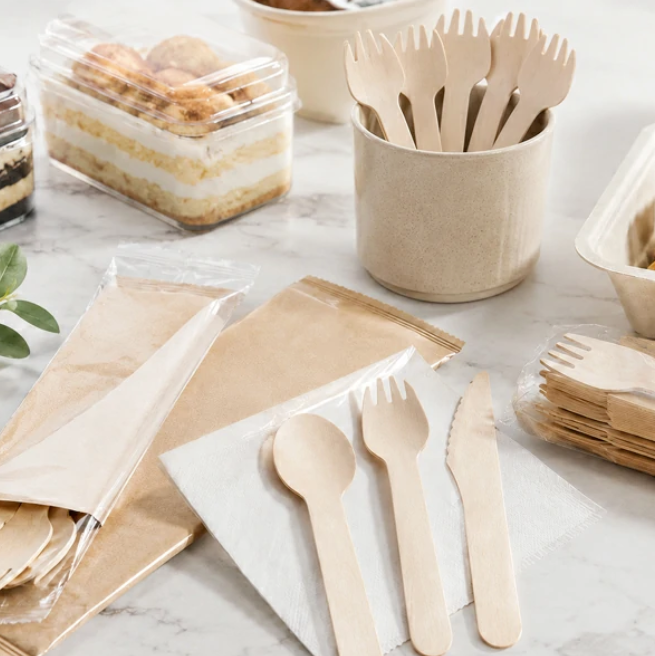
FSC Disposable Wooden Tableware Buyer's Guide: MOQ, Lead Time, Certificates & Pricing
Sourcing FSC disposable wooden tableware at wholesale volume is not a simple price comparison. Minimum order quantities, tooling, certification scope, testing, packaging and shipping terms each shift the true landed cost — and each is negotiable in a different way. This guide gives foodservice, catering and private-label buyers the working numbers and structures they need: an MOQ and lead-time matrix by product family, a certificate and test checklist, a pricing-driver breakdown, a total-cost-of-ownership model and a request-for-quotation template you can send to suppliers today.
How to Read This Guide
The tables below use indicative planning ranges for disposable wooden tableware sourced from an integrated Asian manufacturer. They are benchmarks for budgeting and supplier comparison, not quotations — actual figures depend on your formats, volumes, artwork and destination market. Use them to ask sharper questions, then confirm every number against a written offer.
Volume Logic
MOQ is set by raw-material run length, tooling setup and packaging minimums — not by goodwill.
Lead-Time Logic
Sampling, tooling and testing set the timeline far more than production speed does.
Cost Logic
Unit price is one line in total cost of ownership. Certification and freight often matter more.
MOQ by Product Family
Minimum order quantity is the first filter in any wholesale enquiry. For disposable wooden tableware, MOQ is driven by three things: the raw-material batch the factory must run to be efficient, whether custom tooling or artwork is involved, and the minimum print run for branded packaging. Ready-made stock formats carry the lowest MOQs; fully custom shapes carry the highest.
| Product family | Typical stock MOQ | Custom / private-label MOQ | What drives it |
|---|---|---|---|
| Wooden cutlery (forks, knives, spoons) | 50,000–100,000 pcs | 200,000–500,000 pcs | Mould run length; print plates for branded sleeves |
| Wooden plates & boats | 30,000–50,000 pcs | 100,000–200,000 pcs | Press tooling; size variety |
| Wooden cups & cones | 30,000–60,000 pcs | 100,000–300,000 pcs | Forming tooling; coating selection |
| Ice cream sticks & spoons | 100,000–300,000 pcs | 500,000 pcs+ | Very high-speed lines; low unit value |
| Coffee stirrers | 200,000–500,000 pcs | 1,000,000 pcs+ | Commodity item; efficiency at scale |
| Boxes & mousse boxes | 20,000–50,000 pcs | 50,000–150,000 pcs | Die-cutting tooling; retail graphics |
Two practical notes. First, MOQ is usually quoted in pieces, but packaging can bind earlier than pieces do: a retail-ready inner pack with a printed sleeve may force a higher run than the product itself. Second, MOQ often falls once you become a repeat buyer with existing tooling — so if a first order is too large, ask about a trial quantity with stock packaging, then move to custom packaging on the second run. You can compare families side by side in our FSC disposable wooden tableware range.
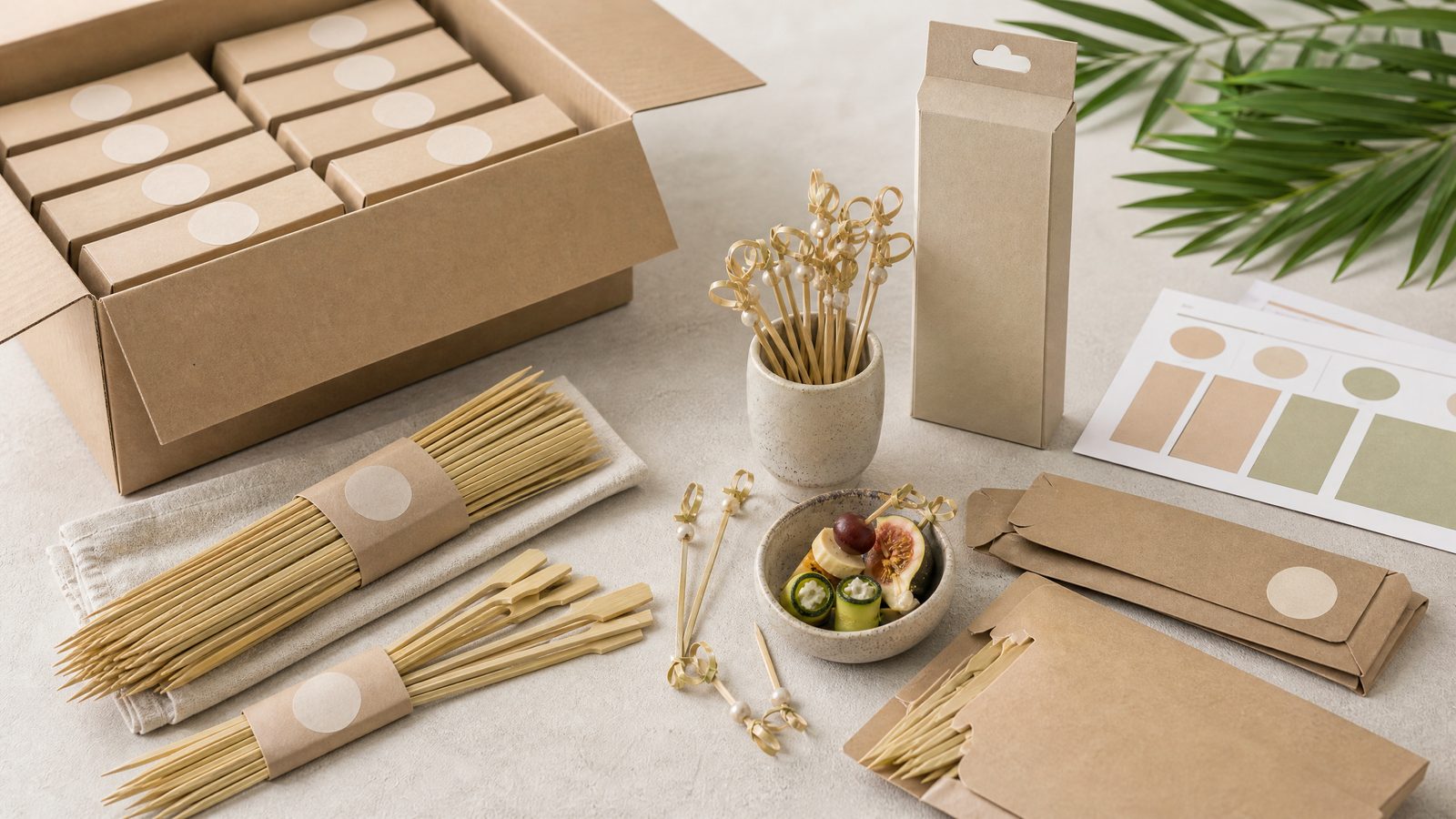
Lead Time: Where the Weeks Actually Go
Buyers often assume lead time equals production time. In reality, production is one block inside a longer sequence, and sampling and tooling dominate for new or custom items.
| Stage | Stock / repeat order | New custom order | Notes |
|---|---|---|---|
| Quotation & specification sign-off | 2–4 days | 5–10 days | Faster with a complete RFQ template |
| Sampling (prototype) | Not required | 7–15 days | Stock formats skip this entirely |
| Tooling & artwork prep | Not required | 10–25 days | Dies, moulds, print plates |
| Pre-production sample (PP) | Not required | 5–10 days | Mandatory sign-off gate |
| Production | 10–20 days | 15–30 days | Scale and coating affect duration |
| QC & third-party inspection | 2–4 days | 3–7 days | AQL final inspection |
| Export docs & booking | 3–7 days | 3–7 days | Vessel schedule dependent |
The practical read: a stock repeat order can ship in roughly three to four weeks, while a new custom programme realistically needs seven to twelve weeks from brief to dispatch. If your launch date is fixed, work backwards from the ship date and treat PP sign-off as the critical path — every day lost there pushes the whole programme. For ready-made formats that shorten that path, see our FSC disposable wooden cutlery line.
Certificates & Tests: The Document Checklist
FSC is the sourcing claim; it is not a safety, performance or end-of-life claim. A complete document set stacks several credentials, each with its own scope and issuing body. Ask for the exact documents below against your SKU and destination market.
| Document | What it proves | Issued by | Ask for it when |
|---|---|---|---|
| FSC Chain of Custody certificate | Certified wood/fibre traceability and claim type | FSC-accredited certification body | Always, if you make an FSC claim |
| Batch-level CoC documentation | Links your shipment to certified inputs | Supplier | Every order with an FSC claim |
| Food-contact declaration & migration test | Material safe for food contact | ISO/IEC 17025 lab | Always, for finished article |
| Compostability certificate (EN 13432 / ASTM D6400) | End-of-life claim validity | Accredited lab / certifier | If you claim compostable |
| Material safety data sheet (MSDS) | Coatings, inks, additives disclosed | Supplier / material maker | Always |
| ISO 9001 / ISO 14001 | Quality and environmental management | Certification body | If your policy requires it |
| Third-party inspection report | AQL final inspection, batch evidence | SGS / BV / Intertek etc. | Before release to ship |
The Most Common Documentation Gap
Suppliers frequently provide tests on the raw material only, while your packaging claim applies to the finished, printed and coated article. Always specify "tests performed on finished, printed and coated samples" and require report identifiers you can verify.
Pricing Drivers: What Actually Moves the Quote
Unit price is the sum of several moving parts. Understanding them lets you negotiate the right lever instead of pushing blindly on price.
| Cost driver | Impact on unit price | How to influence it |
|---|---|---|
| FSC-certified feedstock | Premium over uncertified wood | Accept FSC Mix where the tender allows; commit volume |
| Tooling & print plates | One-off, amortised over order qty | Increase volume, or reuse stock tooling |
| Coating / surface finish | Low to moderate per unit | Choose finish by food type, not by default |
| Printing / branding | Scales with colours and coverage | Reduce colours; simplify artwork |
| Packaging format | Retail-ready costs more than bulk | Use bulk for foodservice, retail only where needed |
| Testing & certification | Per-market, per-SKU | Agree who pays re-tests after formulation change |
| Freight & Incoterms | Often the largest swing factor | Compare FOB vs CIF vs DDP landed cost |

Total Cost of Ownership: A Worked Structure
Comparing suppliers on unit price alone hides the costs that decide whether a programme is profitable. Build a landed-cost model with these lines, then compare total cost per 1,000 units served.
| Cost line | Typical basis | Watch-outs |
|---|---|---|
| Unit product cost | Per 1,000 pcs, FOB | Confirm what is excluded |
| Tooling amortisation | One-off ÷ order qty | Theft of amortisation across repeat orders |
| Certification & testing | Per SKU, per market | Re-test costs after changes |
| Packaging | Per unit or per carton | Retail-ready premium |
| Freight & insurance | Per container / CBM | Lane volatility, Incoterms scope |
| Duty & EPR fees | Destination market | Varies by country and material |
| Warehousing & handling | Per pallet / month | Buffer-stock carrying cost |
| Rejection & rework | % of order | Poor QC inflates TCO fast |
A supplier quoting a slightly higher unit price but bundling certified feedstock, finished-article testing and retail-ready packaging can easily beat a cheaper quote once the full structure is filled in. Ask every shortlisted supplier to quote against the same RFQ template so the comparison is apples to apples — details below.
Need a comparable quote, not a headline price?
Send us your formats, volumes and destination market, and we will return a landed-cost-ready offer with FSC scope, testing and packaging clearly itemised.
Request a wholesale quote →Payment Terms, Incoterms and Risk
Commercial terms decide who carries risk at each point in the journey. Align them early, in writing.
| Term | Typical for new buyers | Typical for repeat buyers | Risk sits with |
|---|---|---|---|
| Deposit / balance | 30% deposit, 70% before shipment | Negotiable, possible credit terms | Buyer until shipment |
| FOB | Common default | Common | Buyer from port of loading |
| CIF | Simplifies logistics | Common | Supplier until destination port |
| DDP | Rarely offered | Possible for large programmes | Supplier to your door |
| Inspection clause | Pre-shipment AQL | Pre-shipment AQL | Define rejection remedy |
Negotiation Order That Works
Negotiate in this sequence: (1) specification and claim type, (2) MOQ and packaging, (3) tooling amortisation and payment terms, (4) Incoterms and freight, (5) unit price last. Price is the hardest lever to move and the first buyers pull — but the earlier levers often save more.
Qualifying a Supplier: A Short Screen
Before you invest time in samples, run a fast screen. A supplier that fails any green row is not worth a second email.
| Check | Pass condition | Red flag |
|---|---|---|
| FSC certificate | Valid, in date, scope covers your product | Expired or "we are applying" |
| Legal entity match | Certificate name = invoice name | Trading-name mismatch |
| Finished-article testing | Reports on printed/coated SKU | Raw-material tests only |
| Third-party inspection | Willing to allow AQL inspection | Refuses inspection |
| Change control | Notifies you of material changes | Vague on sourcing |
| References | Similar B2B / private-label work | No verifiable references |
RFQ Template: What to Send a Supplier
Use this structure so every supplier quotes against identical requirements. A tight RFQ is the single fastest way to shorten the quotation stage and avoid re-quotes.
Buyer & project
Company, project name, target launch date and destination market(s).
SKUs & volumes
SKU code, description, annual and launch volumes, forecast cadence.
Certification required
FSC claim type, food-contact standard, any compostability standard by name.
Technical spec
Dimensions and tolerances, weight/grammage, finish, coating, printing and artwork requirements.
Packaging & labelling
Inner/outer pack, palletisation, barcodes, retail-ready or bulk.
QC, testing & documents
Inspection points, acceptable labs, and the document checklist above.
Commercial terms
Payment, Incoterms, MOQ expectations, tooling and change-control clauses.
FSC Buyer FAQ: MOQ, Lead Time and Pricing
Q1 — What is a typical MOQ for FSC disposable wooden tableware?
Stock formats commonly start at 20,000–100,000 pieces depending on the family, while custom or private-label runs typically require 100,000–500,000 pieces. High-volume commodity items such as stirrers and ice cream sticks sit at the top end.
Q2 — How long does a first order take?
Plan on roughly seven to twelve weeks from brief to dispatch for a new custom programme. Repeat stock orders can ship in about three to four weeks.
Q3 — Does buying FSC-certified tableware cost much more?
Certified feedstock carries a premium over uncertified wood, but the impact on landed cost is often modest and can be offset by accepting FSC Mix where your policy allows and by committing volume.
Q4 — Can I reduce the MOQ?
Often yes. Use stock packaging for a trial order, then move to custom packaging on a repeat run once tooling exists. MOQ also tends to fall once you are an established buyer.
Q5 — Which Incoterm is best for a first order?
FOB is the most common default and gives you control of freight; CIF simplifies logistics if you would rather not arrange carriage. Compare landed cost under both before deciding.
Q6 — Who pays for testing and re-testing?
Agree this in writing. Initial testing is usually supplier-funded for a standard SKU; re-tests triggered by your own spec changes are normally buyer-funded. Clarify before ordering.
Q7 — How do I compare two quotes fairly?
Issue one RFQ template, then compare landed cost per 1,000 units including tooling amortisation, testing, packaging, freight and duty — not headline unit price.
Q8 — Can I get FSC documents on a small trial order?
Documentation should accompany any FSC claim regardless of volume. If a supplier will only provide batch documents above a set volume, agree that threshold in writing before committing.
Next Steps
Start by issuing a single RFQ template to two or three shortlisted suppliers, and require the document checklist against your exact SKU. Then compare landed cost, not headline price — and confirm every FSC claim with a matching certificate and batch-level paperwork.
Build your RFQ from the template above
Fill in SKUs, volumes, certification and packaging, then send it unchanged to each supplier.
Compare families and formats
Review the FSC disposable wooden tableware, FSC wooden cutlery and FSC disposable wooden plates ranges to shortlist what fits your menu.
Request a landed-cost quote
Use our contact form to send your RFQ and receive a quote with FSC scope, testing and packaging itemised.
Get an itemised FSC wooden tableware quote
Send your RFQ and target market, and we will return pricing, MOQ, lead time and the full document checklist for each SKU.
Start your RFQ →Leafyest manufactures FSC disposable wooden tableware, cutlery, plates, cups and ice cream sticks for foodservice, catering and private-label buyers, with documented certification and export-ready logistics. For the certification background behind these numbers, read our companion guide on what "FSC-certified" really means.