FSC Disposable Wooden Tableware: The Weight and Thickness Specification Guide for B2B Buyers
- Share
- publisher
- Leafyest
- Issue Time
- Nov 7,2026
Summary
Specify FSC disposable wooden tableware by wall thickness, piece weight and carton weight. Real millimetre specs for wooden cutlery, cups, cones and mousse boxes, plus how thickness changes freight cost.
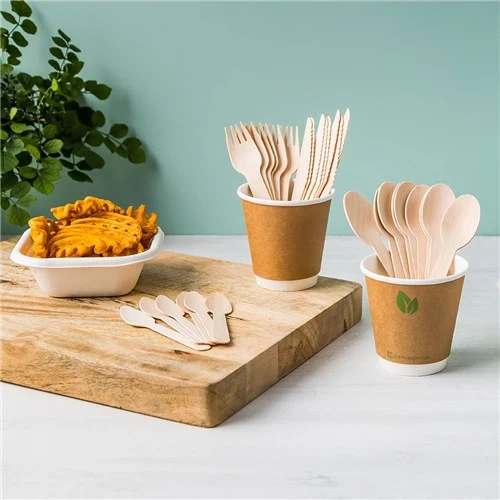
FSC Disposable Wooden Tableware: The Weight and Thickness Specification Guide for B2B Buyers
Two tableware items can carry the same length in the catalogue and behave completely differently on the table. Thickness in millimetres, piece weight in grams and packed carton weight in kilograms decide whether a wooden fork snaps, a plate flexes, and whether your freight quote holds. This guide turns those three numbers into a buying method for the FSC disposable wooden tableware range.
Quick Answer: Specify FSC disposable wooden tableware by wall thickness first, length second. Cutlery is typically 1.2–1.7 mm thick, dessert containers 40–100 mm across, and wooden cutlery sets pack at 500 sets per carton. Ask your supplier for length × width × thickness in millimetres, grams per piece, and carton gross weight — then price the freight against real kilos, not against piece counts.
Most sourcing briefs arrive as a photograph and a quantity. That is enough to start a conversation and not enough to place an order safely. A 140 mm wooden spoon and a 160 mm wooden spoon are both "small cutlery" in a trade-show catalogue, yet one of them reaches the base of a dessert cup and the other does not.
This guide is written for buyers who already know they want wood and now need to lock the numbers.
What Do Length, Width and Wall Thickness Actually Control?
Each of the three numbers answers a different question, and buyers who track only one of them usually get the other two wrong. Length decides reach into the container. Width decides how much food the head of the tool can pick up. Thickness decides how the item behaves when the load arrives.
Length is the most visible figure and the least useful on its own. A 140 mm wooden spoon reaches comfortably into a standard takeaway box; the same spoon disappears into a 200 mm noodle bowl. Width is what the customer feels: a 34 mm spoon bowl lifts a full scoop of rice, while a 20 mm bowl lifts a taste.
Thickness is the quiet one that sets stiffness, and stiffness is what customers describe as quality when they say a fork feels flimsy. Two items with identical length and width, one at 1.2 mm and one at 1.6 mm, will generate two different complaint lists.
It covers how we at Leafyest dimension the FSC disposable wooden tableware range, which measurements actually predict performance, and how to convert those measurements into carton, pallet and freight figures you can defend in a budget meeting.
Where Do the Numbers Come From?
Everything in the tables below comes from our published product data in the Leafyest catalogue, drawn from the presses and moulds currently in production. Where a figure is not published, this article says so instead of filling the gap with an estimate.
Two material notes sit behind all of it. Cutlery and spoons are produced in birch wood, which is denser and takes a smoother machined edge for the part that touches the mouth. Plates, boats, cones, cups and mousse boxes are pressed from poplar wood, which forms shallow three-dimensional shapes reliably at volume.
Every format in the range ships in natural wood colour, is marked biodegradable in our data, and carries the same six-credential listing documented on our certificates page: FSC, LFGB, BRC, BSCI, SGS and FDA. Hot-stamped logos are the standard branding method across plates, boats, cups and spoons.
Which Cutlery Thickness Should You Specify?
Cutlery thickness is the single most useful specification figure in the range, because it is the number that predicts snap. Our spoons and forks cluster at 1.6 mm, the shorter dessert formats drop to 1.2–1.4 mm, and the heavier forks rise to 1.7 mm.
The pattern is deliberate. Short items travel a short distance from container to mouth and carry light loads, so 1.2 mm is enough. Long items carry a full portion over a longer lever arm, so 1.6 mm becomes the working minimum and 1.7 mm is used where a fork has to pierce rather than lift. The same logic applies across the wooden knives and sporks in the range.
If your menu mixes a light dessert programme with a hot savoury programme, do not average the two.
Why Do Thickness and Weight Matter More Than Piece Count?
Piece count tells you how many items leave the factory. Thickness tells you whether each item survives the trip to the customer's mouth. A fork at 1.2 mm and a fork at 1.6 mm look almost identical in a photo, but the second resists bending under a 200 g portion and the first does not.
Weight matters for a different reason: it is the only figure that turns into money. Ocean and air freight, warehouse storage and last-mile delivery all price on kilograms or cubic metres, so a 6 % difference in piece weight becomes a visible line item across a container.
This is why we publish dimensions as length × width × thickness rather than as a single size word, and why we quote freight from carton data instead of from piece counts.
Specify a thin dessert spoon and a separate 1.6 mm main-course spoon, because one thickness cannot satisfy both without over-spending on the dessert line or under-specifying the hot line.| Item | Confirmed size (mm) | Thickness | Best use |
|---|---|---|---|
| Wooden spoon | 96 × 20 | 1.4 mm | Small dessert cup, tasting service |
| Wooden spoon | 140 × 28 | 1.6 mm | Standard boat, medium plate |
| Wooden spoon | 160 × 34 | 1.6 mm | Takeaway box, buffet line |
| Wooden spoon | 185 × 34 | 1.6 mm | Large boat, deep box |
| Wooden fork | 125 × 23 | 1.4 mm | Fruit, pastry, light salads |
| Wooden fork | 140 × 23 | 1.6 mm | General catering |
| Wooden fork | 160 × 26 | 1.6 mm | Main course, delivery |
| Wooden fork | 185 × 27 | 1.7 mm | Heavy portions, dense protein |
| Wooden knife | 140 × 18 | 1.6 mm | Butter, soft desserts |
| Wooden knife | 165 × 22 | 1.6 mm | General cutting |
| Wooden spork | 92 × 25 | 1.4 mm | Sample cups, gelato |
| Wooden spork | 105 × 25 | 1.2 mm | Mousse box, small cup |
| Wooden spork | 147 × 31 | 1.6 mm | Mixed menus, one-tool service |
| Wooden spork | 165 × 36 | 1.6 mm | Deep bowl, rice and noodles |
| Fruit fork | 90 × 15 | 1.2 mm | Melon, berries, platters |
| Fruit fork | 140 × 11.3 | 1.35 mm | Longer tine reach, plated fruit |
Read the range, not the axis: length rises faster than thickness across the range. Going from 96 mm to 185 mm nearly doubles the length while thickness rises only from 1.4 mm to 1.6–1.7 mm. That is why the bending load on a long spoon comes from the lever, not from a thin wall.
One more distinction worth putting on paper: nominal thickness and accepted tolerance are not the same figure. Nominal is the number the tool is designed around; tolerance is how far a production run may drift from it. A supplier who quotes nominal only has told you half of what your QA team needs, and the missing half is the half that generates rejected cartons. Our procurement-facing walkthrough of how procurement teams select spoons, forks and knives uses the same distinction between nominal and accepted size.
Bowls, Boats and Plates: Reading Footprint Instead of Length
Flat and formed formats do not have a "length" in the way cutlery does, so they are specified by footprint. A wooden boat is described by its open top and its wall height; a plate by its diameter or its edge dimension plus rim depth; a mousse box by its square footprint.
This matters because footprint drives packing density. Two boats of similar capacity can occupy different volumes once nested, and nesting is what sets cartons per pallet. When you compare quotes across suppliers, compare footprints at the same nominal capacity rather than the capacities alone.
Plate dimensions across our round, square, rectangular, petal and heart shapes are listed by size band rather than by millimetre figures in our published data, with the heart-shaped plate confirmed at 135 × 137 × 14.5 mm. Treat the remaining band labels as indicative and ask for a millimetre drawing before you commit.
One practical arithmetic check: divide the footprint area by the nominal capacity in grams. A boat that carries 350 g on a small footprint looks efficient on paper and collapses in a delivery bag, while the same capacity spread across a wider open top survives. Footprint per gram is the number that predicts spill, and it costs nothing to calculate from the drawings your supplier should already have.
What Do Dessert and Cup Dimensions Tell You?
Container dimensions invert the logic of cutlery. For a cup or mousse box, the diameter sets the portion size and the height sets the spoon length you need to supply alongside it. Get that pairing wrong and the customer ends up with fingers in the cream.
Our mousse boxes run 40 × 40, 60 × 60, 80 × 80 and 100 × 100 mm square. Wooden cups run from Φ45 × 45 mm square cup and Φ50 × 20 mm shallow cup up to Φ60 × 90 × 30 mm, with heat-resistant variants at Φ55 × 55 mm. Wooden cones run 90 × 125 mm, 130 × 185 mm, 140 × 200 mm and 155 × 220 mm.
A practical rule for the pairing: the serving tool should be at least the container height plus about 30 mm of grip. A 60 mm-high cup therefore pairs with a 92–105 mm spork, while a 90 mm-high cup needs 120 mm or more.
Apply the rule to the shallow end and it becomes obvious why the 50 mm cup exists at only 20 mm deep. That format is not a drinking cup; it is a tasting or portioning vessel for a single bite of gelato, and pairing it with a 165 mm spork would look absurd on the counter. Pairing it with a 92 mm spork keeps the whole serve proportionate. For a dessert-specific view of the same format, our guide to disposable wooden mousse cups walks through the box side of the pairing.
How Do Thickness and Carton Weight Change Your Freight?
Freight is where thickness stops being a quality question and becomes a commercial one. A cutlery set packs at 500 sets per carton in standard configuration, so the carton's gross weight — not the price per set — is what your forwarder will rate.
Because piece weight varies with length, width and thickness, a carton of 500 heavy 185 mm forks and a carton of 500 light 96 mm spoons sit at noticeably different gross weights, and both are the same height on a pallet. Ask for gross weight per carton and cartons per pallet before you compare two suppliers on unit price.
We quote freight from the actual carton data for your specification rather than from a generic per-piece figure. Grams per piece and carton gross weight for each format are to be confirmed against the exact size, logo method and packing you order.
There is a second freight lever that most buyers notice late: nesting ratio. Cups, cones and boats stack inside one another, so the packed height of a carton is set by wall angle and rim profile rather than by piece count alone. A format that nests poorly can add a measurable share of a container to the same order quantity, and no per-piece price comparison will reveal it. Ask for pieces per carton and carton dimensions together, and compute cubic metres per thousand covers as your real comparison figure. If your format mix is mostly cutlery, the individually packaged versus bulk cutlery comparison shows how packing choice moves the same order.
| Specification question | What the answer changes | Where to get it |
|---|---|---|
| Piece weight in grams | Total shipment kilograms and freight cost | To be confirmed per format on your spec sheet |
| Carton quantity | Order maths and carton count | 500 sets/ctn for cutlery sets; other formats to be confirmed |
| Carton gross weight | Pallet load and container fill | To be confirmed with packing details |
| Cartons per pallet | Storage footprint and unloading time | To be confirmed against your pallet standard |
| Individually wrapped or bulk | Volume, labour, hygiene and unit cost | Both listed as standard packing options |


There is a second freight lever that buyers notice late: nesting ratio. Cups, cones and boats stack inside one another, so the packed height of a carton is set by the wall angle and the rim profile rather than by the number of pieces. A format that nests poorly can add a measurable share of a container to the same order quantity, and no per-piece price comparison will reveal it. Ask for pieces per carton and carton dimensions together, then compute cubic metres per thousand covers as your real comparison figure.
Does a Thicker Wall Always Mean a Better Product?
The check a buyer can run in one afternoon
Take ten pieces of each candidate format and load each one with 20 % more than your heaviest real portion. Hold the loaded item by the handle for two minutes, then lift it from the rim of the container. Any format that flexes visibly, or that lets the food shift, fails regardless of what the spec sheet promised.
Our recommendation to every new buyer is the same: order a sample set across two thicknesses for each format you intend to sell, run the test with your own dishes, and only then fix the specification for the season. Sampling costs a fraction of a container and settles arguments that otherwise repeat at every quarterly review.
On the sourcing side, put length, width, thickness, species, grams per piece, carton quantity and packing on one page, get it countersigned, and keep it with the purchase order. A specification that lives only in an email thread is not a specification.
No. Thickness buys stiffness and loses flatness tolerance, nesting efficiency and packed density. A plate pressed too thick will stack with visible gaps, which reduces plates per carton and raises the freight cost per cover.
The right thickness is the thinnest one that passes your own service test. For a flat plate carrying a dry pastry that may be 1.2 mm; for a boat holding a 450 g wet salad it will not be. Testing is the only honest way to settle the question, and it is cheap compared with a container that arrives too flexible to sell.
One practical caution: thickness tolerances are not published for every format in our catalogue. Where a tolerance is not stated, treat the dimension as nominal and ask us to confirm the accepted range in writing before you build a quality clause around it.
The same logic applies to added finishes. Waxing and polishing with Brazilian palm wax improves the feel of cutlery in the hand, and hot stamping puts a brand on the handle, but neither adds structural stiffness. A buyer who needs a stronger fork needs thickness, not a surface treatment, and confusing the two is how specifications grow expensive without growing reliable.
How Does Freezer and Chilled Service Change the Spec?
Cold service does not require more thickness; it requires the right moisture state. Moisture in the wood behaves like a slow spring — it moves in and out with ambient humidity, and it changes both weight and flatness while the product sits in your warehouse.
Wood is hygroscopic, so cartons that sit in a humid loading dock and then move into cold storage will not perform identically to cartons that stayed dry. Our freight, storage and takeout specification guide covers the same variable from the transit side. Keep cartons closed, off concrete floors, and staged in a dry area before they go to the line.
Weight moves with moisture, which is why a carton weighed on a rainy dock can read differently from the same carton weighed in a dry warehouse. Treat quoted piece weight as a dry-state reference figure and allow a tolerance band when you plan freight. Specific storage temperature and humidity bands for freezer, chilled and ambient conditions are to be confirmed for your formats and destination market rather than assumed. For the retail-facing variation of the same question, see how to build a carry-out set that actually works.
Specific storage temperature and humidity bands for freezer, chilled and ambient warehouse conditions are to be confirmed for your formats and destination market rather than assumed from a general figure.
What Should You Put in the Specification Sheet?
A defensible specification sheet uses numbers a factory can press to and a QA team can measure. Write it once, reuse it across suppliers, and the comparison becomes arithmetic instead of opinion.
We accept dimensions, material, logo method and packing as the four changeable layers across the range, which is why the sheet below separates what you are buying from how you are buying it.
Dimensions
Record length × width × thickness in mm for cutlery, and diameter × height for cups, cones and mousse boxes. State the measurement method, not just the number.
Material and finish
Name the species — birch for cutlery, poplar for pressed formats — and record whether the food-contact surface stays uncoated. Our birch cutlery can be waxed and polished with Brazilian palm wax on request.
Piece and carton weight
Add grams per piece and carton gross weight to the sheet. These two numbers turn a spec into a freight model you can budget against.
Packing format
Choose from polybag plus label, polybag plus headcard, paper box, PET box, paper box with PET lid, display box, shrink pack or individual pack on our customized service page. Packing changes volume more than weight.
Branding and documents
Lock the logo method (hot stamping or laser) and attach the certificate list you require, then confirm that the certified site is the factory that will press your order — what an FSC certification claim really covers explains the scope question.
Two habits make the sheet usable rather than decorative. First, write it in the units the factory presses to, so nobody converts centimetres to millimetres at the approval stage. Second, attach a photograph of the measurement point for thickness, since a figure taken at the handle and a figure taken at the bowl are different numbers, and suppliers do not always state which one they mean.
Where Do Lead Time and Order Size Fit the Numbers?
Lead time is not a specification figure, but it is driven by one. A stock format with stock packing moves fastest; a new thickness, a new shape or a printed sleeve adds a tooling and approval cycle on top of production.
Our customisation process describes a nine-step flow: design consultation, initial sketch, sketch feedback, design finalisation, mould making, sample production, sample confirmation, formal production and delivery. Each of those steps consumes calendar days that have nothing to do with press speed.
Specific lead-time days and minimum order quantities for your specification are to be confirmed with your quotation; the MOQ, lead time and pricing guide sets out which variables drive them. We quote both per order, because two buyers ordering the same format can face very different schedules once packing and artwork are included.
Send Us Your Specification Sheet
Give us length × width × thickness, grams per piece where you have it, monthly volume by format and your packing choice. We will confirm the closest match in the range and quote against your numbers.
Request a Dimensional MatchFrequently Asked Questions
Q1 — Is 1.6 mm thick enough for a main-course fork?
Yes, for most delivery and buffet service. Our 160 × 26 mm and 185 × 27 mm wooden forks are confirmed at 1.6 mm and 1.7 mm respectively, which suits a full portion lifted over a short lever. Test against your heaviest real dish before approving.
Q2 — Can I get a thickness that is not in the catalogue?
Dimension changes are part of our OEM and ODM work, and they normally require a mould and a sample cycle. See the customization service for the full sequence. Ask for the practical range per format first, because pressing thinner than the tooling allows affects stiffness more than weight.
Q3 — Does individually wrapping each piece change the freight?
It changes volume far more than weight, which is why individually wrapped and bulk cutlery price differently per cover. Individual wrap, polybag plus headcard and display box options all raise packed volume per piece, so a container fills sooner even though the gross weight barely moves. Model cubic metres, not only kilograms.
Q4 — Why is the mousse box listed as 40 × 40 mm rather than in grams?
Because container formats are specified by footprint and height, not by weight. The 40, 60, 80 and 100 mm figures are square footprints, and the height determines which spoon length you should pair with the box.
Q5 — How do I compare two suppliers on thickness alone?
Ask both to state nominal thickness, the accepted tolerance range, and the measurement point on the item; FSC versus non-FSC cutlery is a useful worked example of comparing like with like. A figure quoted at the handle and a figure quoted at the bowl are not the same number, and the difference is often larger than the gap between suppliers.
Q6 — Does the FSC claim change with thickness or packing?
The certificate covers chain of custody for the wood, so it stays with the material rather than with the thickness or the packing.
Get the Numbers in Writing Before the Container Is Booked
The cheapest mistake to avoid is a specification that lives only in an email thread. Put length, width, thickness, species, piece weight, carton quantity and packing on one page, get it countersigned, and keep it with the purchase order.
For the full range of formats behind these figures, browse the FSC disposable wooden tableware category, the wooden spoons, forks, knives, sporks, fruit forks and cutlery sets, the plates, boats, cones and wooden boxes for serving, or the bamboo cutlery and mousse boxes used for dessert service. Ice cream programmes can compare stick formats in the Magnum versus standard stick guide.
Leafyest, an FSC disposable wooden tableware manufacturer based in Hailin, Heilongjiang, operates a factory of more than 10,000 m² with over 200 staff, accepts OEM and ODM work, and ships FOB Dalian with payment by L/C, T/T or PayPal. Send your specification and we will reply with a dimensional match and a quotation against your volume.
Ask About Thickness, Weight and Packing
Tell us the formats, the thickness you need and the packing you sell in. We will confirm what the tooling supports and what the carton will weigh.
Ask About Specification